Sitting on the Sidelines because of Interest Rates?
Why You Should Buy — If You're Willing and Able — Instead of Rent
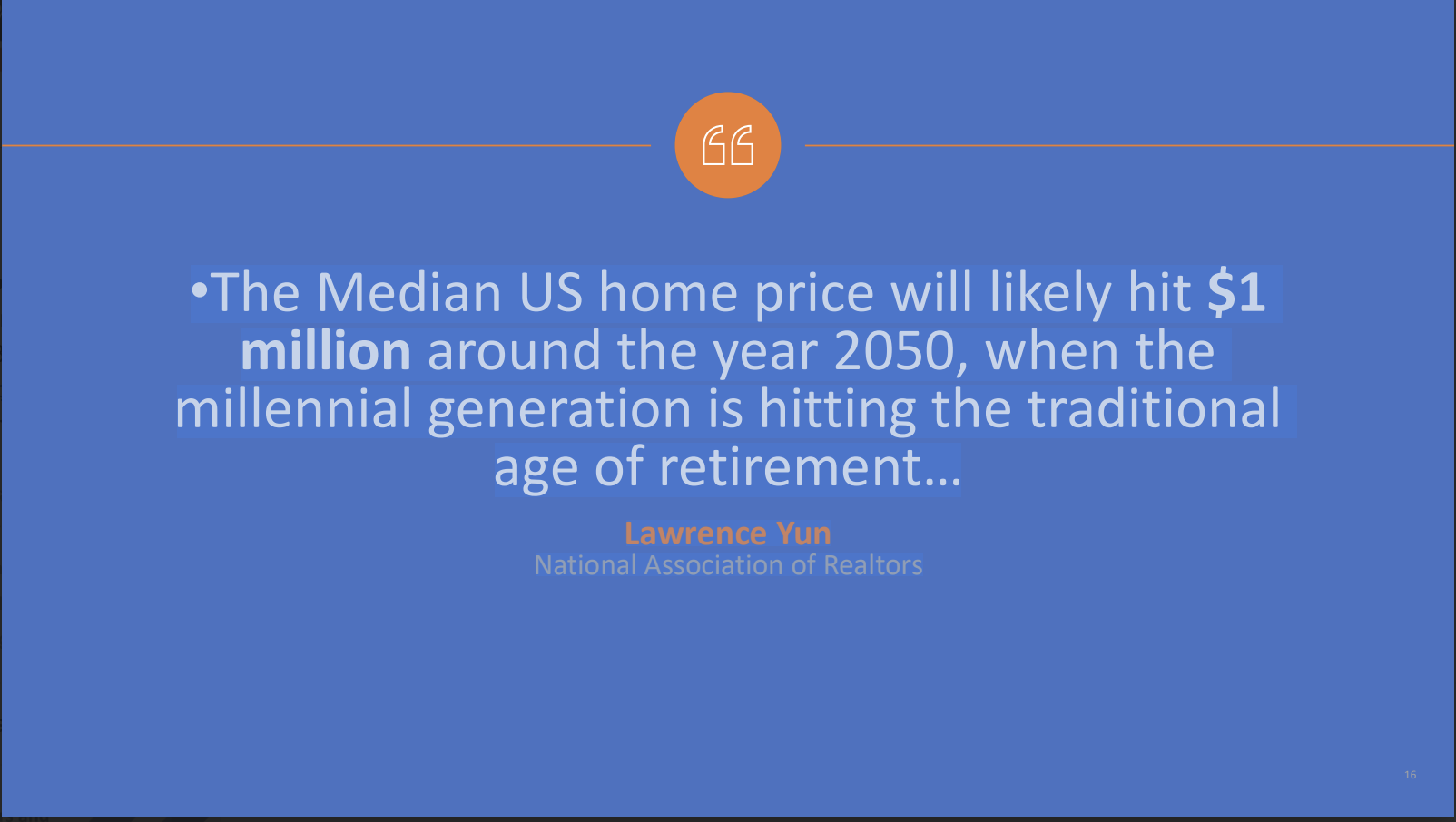
Lawrence Yun, chief economist for the National Association of Realtors, recently offered a projection that should reframe how you think about the decision to buy or rent: the median U.S. home price will likely hit $1 million around 2050, right as the millennial generation reaches traditional retirement age. Speaking at a housing conference, Yun put it plainly: "Essentially, in about 25 years the national median home price will be a million dollars." He noted that in 1990, the national median was just $90,000. His forecast isn't a guess pulled from thin air — it's based on steady, historically consistent home-price appreciation of 3% to 4% a year, run through multiple forecasting models that all landed in the same range.
That number is worth sitting with. Not because $1 million will mean in 2050 what it means today — inflation will have eaten into that figure too — but because it captures a simple truth about real estate: prices trend upward over long time horizons, and the longer you wait to get in, the more expensive getting in becomes.
The cost of waiting compounds
If home prices climb 3% to 4% annually, every year on the sidelines isn't neutral — it's a year of lost appreciation on a purchase you'll eventually make anyway, at a higher price, on a larger loan. A buyer who purchases today locks in tomorrow's price at today's rate. A renter who waits five or ten years for "the right time" isn't avoiding the cost of the market — they're deferring it, usually at a markup.
This is the core argument for buying when you're willing and able: not that today's price is a bargain, but that today's price is very likely lower than tomorrow's. Yun's $1 million median isn't a warning to stay out of the market. It's a description of what happens to everyone who does.
Rent doesn't build anything
Every rent payment covers this month's housing and nothing else. It builds no equity, creates no asset, and offers no protection against next year's rent increase. A mortgage payment, by contrast, is a forced savings mechanism. Part of it goes to interest, but part of it builds ownership in an asset that history — and Yun's projection — suggests will keep appreciating. Over a 25- or 30-year horizon, that difference compounds into real wealth. It's a major reason homeownership remains the largest source of net worth for most American households.
Millennials are the case study
Yun's timeline is pointed at millennials specifically because they're the generation now moving through prime home-buying years, and the ones who will feel the $1 million median most directly as they approach retirement. Millennials who buy now, even in a market that feels expensive, are positioning themselves the way earlier generations did when $90,000 felt like a lot of money for a house. The ones who wait for prices to come down are betting against decades of market behavior.
"Willing and able" still matters
None of this is a case for buying recklessly. "Willing and able" is the operative phrase — you need stable income, a manageable debt load, and a down payment that doesn't leave you house-poor. Buying before you're financially ready trades one set of problems for another. But for buyers who meet that bar and are simply hesitating because today's prices feel high, Yun's forecast is a reminder that "high" is relative. Today's median will look like 1990's $90,000 soon enough.
The Colorado angle
Colorado's market has followed the national trend closely, and in many metro areas has outpaced it. Buyers here who are qualified and ready face the same math: waiting for a dip rarely beats buying and letting time and appreciation do the work. If you're on the fence, the question isn't whether prices will rise — it's whether you want to be the one who benefited from that rise, or the one who paid for it.